

Never miss an update. Join our newsletter.
You're in.Look for the next issue in your inbox.
11611 San Vicente Blvd. #650
Los Angeles, CA 90049
© 2026 Bonfire Ventures. All rights reserved.
July 7, 2026
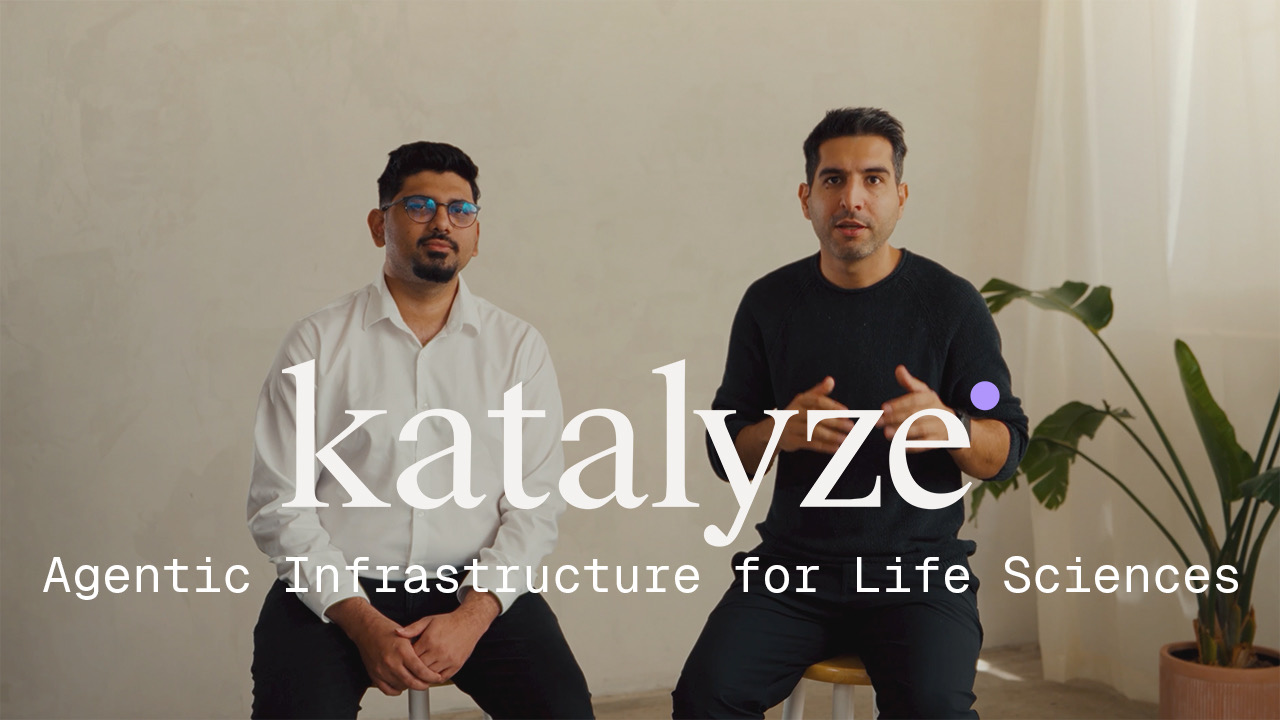

Bonfire Ventures is proud to have led Katalyze’s $10.5M Seed round. Read the announcement here.
Drug manufacturing is one of those categories where small improvements can create massive outcomes.
In biopharma, a single point of yield improvement can mean millions of dollars in value. It can also mean something more important: more access to life-changing drugs that are too often expensive, scarce, and operationally difficult to produce at scale. That is what drew us to Katalyze. The company is building agentic AI for pharma manufacturing, helping some of the world’s largest drug makers identify deviations, improve processes, and increase yield in environments where inefficiency is incredibly costly. In Katalyze’s own words, they are building “the #1 GxP Agent for Pharma Manufacturing,” with AI agents designed to solve deviations faster and run workflows at a fraction of the cost.
What makes this especially compelling is where Katalyze sits in the stack.
This is not AI layered on top of a lightweight workflow problem. It is infrastructure for one of the most operationally complex, tightly regulated industries in the world.
Katalyze starts with biologics manufacturing, where the economics are extreme and the stakes are high, but the long-term opportunity reaches much further across pharma and adjacent categories. Reza Farahani, the company's CEO, described the vision simply: make the operational side of drug manufacturing faster, cheaper, and higher quality, which in turn can help make advanced therapies more accessible.
What really got our attention was the combination of urgency and defensibility.
Pharma manufacturers are under pressure from every direction. They need to improve margins, increase efficiency, reduce expensive manual work, and modernize operations without introducing risk. At the same time, this is not a market where startups can casually land a pilot and call it traction. Winning here means surviving layers of procurement, technical diligence, IT scrutiny, and organizational inertia. In Jen’s diligence, one of the strongest signals was that in active RFPs, Katalyze was the only startup and the only AI-native company being considered. Even more important, they were being selected for a critical part of the manufacturing workflow in an industry that rarely takes chances on young vendors. That tells you something.
We also kept hearing the same thing from the market: the status quo is expensive, fragmented, and overdue for reinvention. In many cases, large pharma companies are still paying consultants and highly specialized experts millions of dollars to do work that should be software-driven. Katalyze is not just cheaper. It is built to do the job differently.
Its platform can reduce the need to add more PhDs and subject matter experts on the manufacturing floor as operations scale, while also helping teams find opportunities to improve output and reduce deviations. Katalyze’s site now frames that value in concrete terms, including “up to 8% uplift of yield” and AI-powered support for process improvement, deviation management, batch release, and traceability.

Underneath that product is a foundation we believe matters a lot: the ontology layer.
One of the hardest problems in pharma is that the data is everywhere and it rarely speaks the same language. Different systems, departments, suppliers, and sites all structure and label information differently. Katalyze has built an ontology layer that unifies those fragmented inputs into a common language, making it possible for AI to reason across manufacturing data in a way legacy tools cannot. That may sound technical, but it is central to why we think this company has the potential to become deeply embedded. In our view, this is the kind of foundational work that separates real platform companies from point solutions and AI band-aids.
We were equally impressed by the team behind it.
Reza did not arrive at this problem from a distance. Before founding Katalyze, he worked on this exact challenge at BCG, seeing firsthand how manual, slow, and inefficient the existing processes were. He understood the pain well enough to know there had to be a better way, then set out to build the system he wished existed. What stood out in our conversations was not just his domain fluency, but his ability to sell into a brutally difficult market. When we first met him, Sanofi was an early customer. Over time, we watched him expand that relationship, hire his champion from Sanofi into the business, and bring on Bristol Myers Squibb.
For a company at this stage, that kind of customer momentum is not normal. It is a sign of exceptional founder-market fit.
The broader team only strengthened our conviction. Shreyas Becker, Katalyze’s co-founder and COO, came directly from Sanofi, where he was leading AI and data products for manufacturing. That buyer-side perspective matters. He has lived the problem from inside the organization Katalyze now sells to. Hannes, the company’s AI leader, brings deep experience across pharma, healthcare, and AI, and has played a key role in building the company’s technical backbone. Together, the team brings a rare mix of domain credibility, go-to-market fluency, and technical ambition.
We invest in companies that solve real operational pain with software that can become essential. Katalyze fits that pattern squarely. The company is tackling a problem with clear ROI, selling into customers that are large enough for the value creation to be enormous, and building real technical differentiation in a market where incumbents are still trying to bolt AI onto legacy approaches. More importantly, they are doing it with a team that understands both the science and the system they are trying to change.
There is also a broader reason we are excited. The best vertical AI companies do not just make workflows faster. They reshape how critical industries operate. In pharma manufacturing, better yields, fewer deviations, and more efficient operations do not just improve margins. They can improve resilience, speed, and access across the supply chain behind some of the world’s most important therapies. That is a meaningful wedge, and we believe Katalyze is building from it toward something much bigger.
We are thrilled to back Reza, Shreyas, Hannes, and the Katalyze team as they build the AI infrastructure layer for modern pharma manufacturing.