How to Build a Startup Team: VC-Backed Guide for Seed Stage Hiring
January 16, 2026
By:
Founders want to move fast. But hire too quickly in the seed stage without intention, and real damage can occur. Early hires shape culture, set the tone for how teams operate, and influence whether startups grow past the seed stage or get stuck early on.
Not to mention that employees can account for the biggest part of your budget (sometimes more than 50%). For B2B SaaS founders, learning how to build a startup team isn’t about filling open roles as fast as possible. It’s about making a small number of decisions that carry real weight. The right hire takes work off your plate, moves projects forward, and helps the team run more efficiently.
At Bonfire Ventures, we see this pattern repeat across various stages and founders who slow down just enough to hire with clarity tend to make better progress.
This guide breaks down how to build a startup team step-by-step, using the same hiring principles we share with founders.
Why Building the Right Startup Team Matters
At the seed stage, your team is the group of people you’ll spend the most time with. You’ll talk daily, make major decisions, and solve problems together. With such a small team, every hire has a larger-than-normal impact on how the company operates and grows.
Strong early hires create momentum. They take ownership, push work forward without constant direction, and help execute on major ideas. When the right people are in place, projects move with less friction and founders spend more time on strategy versus day-to-day cleanup.
Your early team also sets the foundation for your product and technical direction. The people you hire now influence what gets built first, how scalable it is, and how thoughtfully the company approaches tradeoffs. Good hires bring judgment capabilities to make smart calls when information is incomplete and multiple priorities exist.
At Bonfire Ventures, we see this pattern play out repeatedly across seed-stage B2B software companies. Early hiring decisions shape execution, how clearly founders can articulate where the company is headed, and whether others want to help build it.
As Bonfire co-founder Mark Mullen puts it, “If the founder’s able to go out, articulate the vision and the story, and really be painting the picture of what the firm is trying to build, he or she will be able to hire incredible people and grow. If you can’t do that, you’re going to fail.”
These hiring decisions influence how investors view the business. A focused team with clear ownership signals strong leadership and readiness to scale. Momentum at the team level often shows up well before it appears in the metrics.
Building the right startup team isn’t about chasing pedigree or hiring the most senior candidates available. It’s about assembling a cohesive group that can move with clarity, reduce friction, and help turn early traction into enduring momentum.
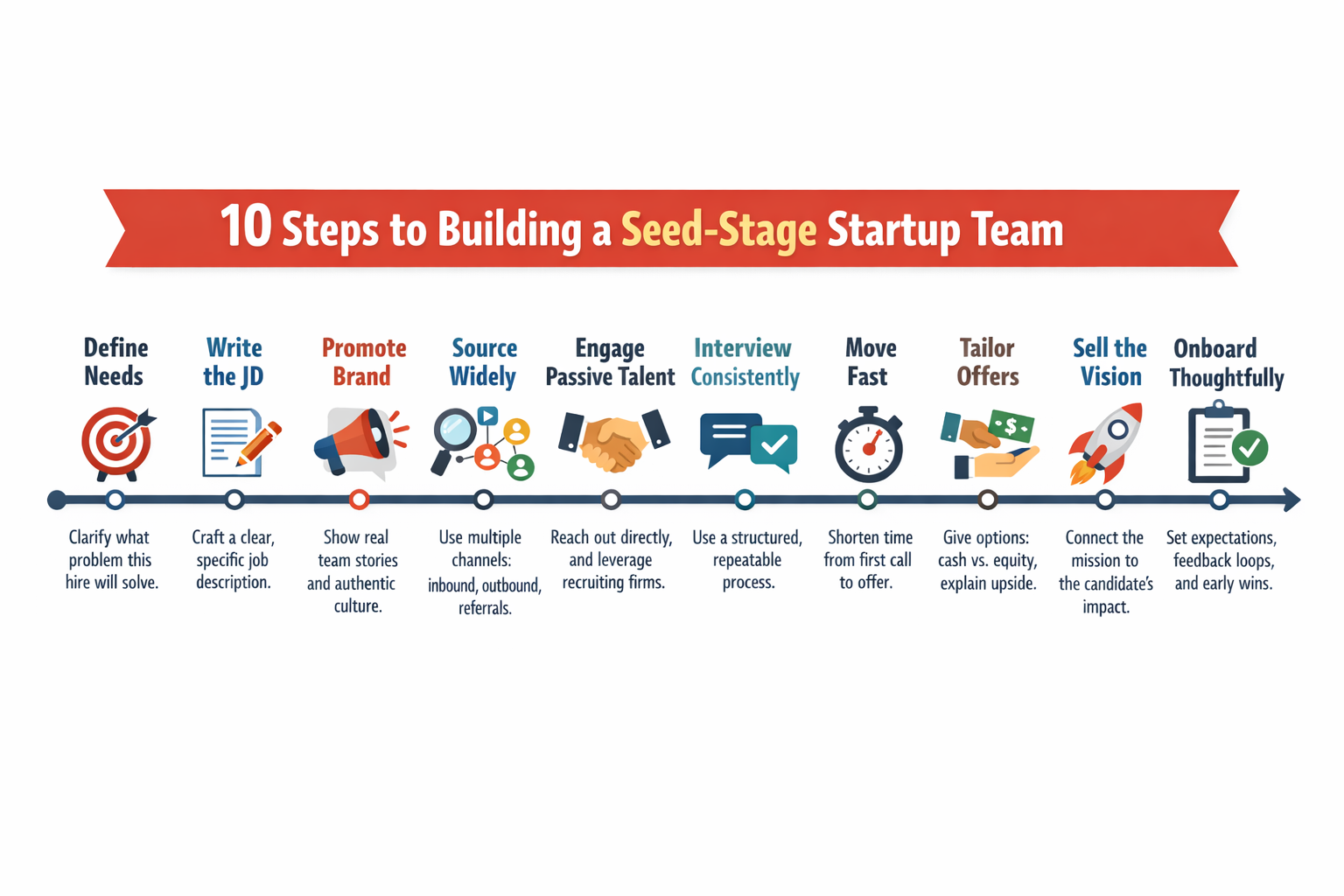
How to Build a Startup Team: Step-by-Step
There’s no perfect formula for hiring, but there are many best practices. This step-by-step guide outlines how to build a startup team that moves progress forward while also keeping an eye toward what comes next.
Step 1: Define and Outline Your Business Needs
According to Gallup, a lack of clear role expectations is one of the biggest barriers to employee performance and engagement. Before you start sourcing candidates, clarify what the hire is actually meant to accomplish. Early hiring works best when you slow down just enough to:
Detail the business problem this hire solves: Start with the problem, not the title. Ask yourself what work isn’t getting done or is pulling you away from higher-impact priorities. This hire should remove a real bottleneck, such as, shipping product, supporting customers, or building repeatable go-to-market motion. If you can’t clearly explain what improves after this person joins, you may not be ready to hire yet.
Determine full-time, contractor, or contract-to-hire: The problem you’re solving should dictate the type of hire. Full-time employees are best for long-term ownership and core responsibilities. Contractors help with short-term or well-defined projects but are usually less invested in the broader business. Contract-to-hire can offer flexibility, but it may turn off strong candidates who want stability, especially for senior roles.
Understand your timeline: Begin interviews when you’re roughly four weeks away from onboarding. Start too early, and it can backfire. If you meet a strong candidate but can’t move quickly, you might lose them if they’re actively interviewing elsewhere.
Avoid interviewing before you’re ready: Don’t treat interviews as “exploratory.” Once you start talking to candidates, you should be prepared to make a decision. The goal is to respect candidate time and move decisively. Strong early hires tend to have options, and drawn-out or uncertain processes are an easy way to lose them.
Get this step right and set the foundation for everything that follows. When the need, role type, and timing are clear, the rest of the hiring process becomes faster and more effective.
Step 2: Create Clear Job Descriptions
Vague roles attract the wrong candidates and slow the process. In fact, studies found that 31% of candidates would immediately drop out of a process if the job description is unclear. Strong candidates want clear information and definitions for:
Role title: Keep titles simple and accurate. Overinflated titles can mislead candidates, while vague ones create confusion. The title should clearly reflect the scope of responsibility today and not what the role might become years from now.
Responsibilities: Be specific about what this person will work on in the first 6 to 12 months. Early hires care less about abstract duties and more about what they’ll actually be building, shipping, or owning week to week.
Success metrics: Define what “doing well” looks like. This could be revenue targets, product milestones, system reliability, or customer outcomes. Clear success metrics help candidates self-select and make it easier to evaluate performance once they join.
Required versus nice-to-have skills: Separate must-have skills from bonus attributes. Overloading a role with requirements narrows your pool and slows hiring. Focus on the few skills that are truly essential to solve the business problem you defined in Step 1.
Cultural expectations: Early teams operate with little structure, so startup fit matters more. Be clear about how your team works when it comes to pace, ownership, communication style, and comfort with ambiguity. This helps candidates understand whether they’ll thrive in your environment.
Beyond outlining the role, explain why someone would want to join your startup. Strong candidates are choosing between multiple options. Share what makes this role compelling, whether it be the impact, learning curve, growth opportunity, or the problem you’re solving.
Step 3: Actively Promote the Brand
Your employer brand isn’t just your logo or careers page. It’s your people. The way your team shows up publicly plays a big role in who decides to engage and who opts out early.
As Sherrie Sitfter, startup recruiter, puts it, “Building a magnetic employer brand is no longer optional – it’s essential for any startup that wants to attract top-tier tech and go-to-market (GTM) talent and win over savvy VCs/angels.”
If you want to attract strong talent for your startup team, aim to:
Encourage team storytelling: Candidates want to hear from the people already doing the work. Encourage team members to share what they’re building, problems they’re solving, and what day-to-day life actually looks like. These stories carry more weight than polished job posts and help attract candidates who resonate with how your team operates.
Share real culture: Authenticity matters more than production value here. Share real moments of how your team collaborates, how decisions get made, and what you care about as a company. Avoid generic startup language. Candidates can easily spot when culture is being oversold or abstracted.
Avoid overposting blindly on job boards: Job boards can generate volume, but volume isn’t always helpful. Posting everywhere without a plan often leads to a flood of unqualified applicants and wasted time. Be intentional about where you post and whether your team has the bandwidth to review inbound thoughtfully.
Consider a short “why join us” video: A simple video that explains why someone should join your team goes a long way. This is often one of the first touchpoints a candidate has with your company. It doesn’t need to be polished, what matters is that it reflects your actual team vibe.
Step 4: Use Multiple Sourcing Channels
Strong candidates rarely come from a single source. In fact, up to 70% of the global workforce is passive talent, meaning they’re not actively applying to job ads and won’t show up in inbound channels. You can reach quality hire with channels like:
LinkedIn job posts: LinkedIn remains the highest-signal platform for startup hiring. It’s a reliable way to generate inbound interest, especially when the role and expectations are clearly defined. Be mindful of volume as more applicants doesn’t always mean better ones.
Employee referrals: Your team’s network is often your strongest sourcing channel. Early employees tend to know others who work similarly and thrive in comparable environments. Even lightweight incentives like public recognition or a small reward can encourage referrals without adding complexity.
Niche job boards: Depending on the role, targeted platforms can be more effective than broad job boards. Sites like Built In for tech roles or AngelList for startup-minded candidates can help you reach people who are already interested in early-stage companies.
Manual LinkedIn sourcing: Outbound sourcing can deliver higher-quality candidates, especially when outreach is personalized. Referencing a candidate’s background, recent work, or experience shows intention and increases response rates. This approach works best when you can move quickly once interest is there.
Agencies: Recruiting agencies make sense when time is tight, you’re hiring multiple roles, or you’re filling senior or executive positions. The right firm can manage sourcing, screening, and coordination, freeing founders up to focus elsewhere.
In short, inbound gives you volume, outbound gives you quality. A strong hiring strategy uses both and avoids overextending the team with more inbound than they can reasonably review.
Step 5: Engage Passive Candidates and Recruiting Firms
Some of the strongest candidates won’t ever apply to your job. They’re either already employed, performing well, or not actively looking. As Great Bay Staffing Group puts it, “When you only recruit from active job seekers, you're essentially competing for candidates who are already being courted by multiple employers.” Reaching the passive group requires a more proactive approach by considering:
Best candidates may not apply: Passive candidates often make the biggest impact, but they rarely show up in inbound pipelines. If you’re only reviewing applications, you’re likely missing a large portion of the talent market especially for senior or specialized roles.
Personalized email outreach: Outbound outreach works best when it’s thoughtful and specific. Whether through LinkedIn or email, reference what the candidate would actually own, build, or influence in the role. Generic messages risk getting ignored.
Agencies as time multipliers: Founder time is limited. At a certain point, sourcing candidates yourself is no longer the best use of it. Recruiting agencies can take on sourcing, screening, and coordination, delivering a steady flow of qualified candidates while you stay focused on running the business.
Firm specialization: Not all recruiting firms are the same. Some specialize in engineering or product roles, others in go-to-market or executive search. Some focus on individual contributors, others on VP-level and above.
Role level before engaging firms: Before bringing in an agency, be clear on the level and scope of the role. Misalignment here leads to poor candidates and wasted cycles. Clear expectations help agencies work faster and more effectively on your behalf.
Step 6: Create a Consistent Interview Process
Sourcing candidates is only half the job. A clear, consistent interview process helps you evaluate talent quickly and create a strong candidate experience. As the Society for Human Resource Management puts it, “When people, platforms, and purpose are aligned, the result is not just a successful hire, but a stronger, more profitable organization.”
Follow this structure to move fast without cutting corners:
1. Initial Screen
Use this stage to quickly confirm whether the candidate is worth deeper time by assessing:
Cultural fit: Ask how they like to work day to day and what environments help them do their best work
Motivation: Ask why they’re considering a change now and what they want in their next role
High-level skills: Ask them to walk through what they personally owned in past roles
Answer quality: Listen for clear, specific examples rather than vague or team-level answers
Risk signals: Watch for deflection, unclear ownership, or discomfort discussing mistakes
2. Technical or Skills Assessment
Use this stage to evaluate role-specific ability by using:
Case studies: Ask candidates to walk through how they would solve a realistic problem your team faces
Whiteboards: Watch how they think out loud, structure problems, and explain tradeoffs
Take-home projects: Review how they prioritize, execute, and communicate their work
Portfolio reviews: Ask them to explain decisions they made and what they would do differently
3. Team Interview
Use this stage to assess how the candidate will work with others by:
Keeping the panel small: Limit interviews to 2 to 3 teammates to avoid overwhelming the candidate
Pre-briefing the team on expectations: Tell interviewers exactly what they should be evaluating
Using consistent evaluation criteria: Ask the same questions across candidates to compare feedback evenly
4. Founder or CEO Final Interview
Use this conversation to close and assess long-term fit by:
Selling the vision: Explain where the company is headed and why this role matters now
Discussing trajectory: Talk through how the role could grow as the company scales
Assessing long-term alignment: Ask about ownership, pace, and how they think about commitment
Step 7: Keep ‘Time to Hire’ Short
Top candidates are often off the market within 10 days. So, speed is your biggest advantage in early-stage hiring. You may not win on compensation, but you can win by moving decisively. A tight process helps you:
Move decisively: Decide in advance how quickly your team will review candidates and make calls, such as providing interview feedback within 48 hours
Respect candidate time: Show up prepared and on time for every conversation, and avoid unnecessary steps that slow momentum
Provide feedback fast: Share clear next steps with candidates or recruiters immediately after interviews to keep the process moving
Offer flexible scheduling: Make it easy for employed candidates to interview by accommodating early mornings, late afternoons, or condensed timelines
Your goal should be to move from initial outreach to offer in 2 to 3 weeks total.
Step 8: Customize Your Offer
Strong candidates are weighing risk, upside, learning, and belief in the company. As Deloitte puts it, “Most workers are driven by a wide range of motivations on a daily basis and often experience multiple motivations at the same time.” Your job is to make the tradeoffs clear and the opportunity easy to understand.
Use a two-offer approach: Present two clear options. One weighted more toward cash and one weighted more toward equity. This gives candidates a sense of control and avoids the feeling of a take-it-or-leave-it offer.
Leave room for negotiation: Most candidates will come back with questions or a counter. Expect that and plan for it. Decide ahead of time where you have flexibility so you can respond quickly without reopening internal debates or slowing down the process.
Explain equity upside clearly: Don’t assume candidates understand equity. Walk through how their equity works, what it represents today, and how it could grow if the company succeeds. Tie the upside directly to the role with what they’ll own, how they’ll contribute, and why their work matters to the company’s future.
Use benchmark tools to stay grounded: Use compensation benchmarks from tools like Pave, Carta, or Levels.fyi to gauge your offer. These tools help you stay competitive and avoid under- or over-shooting market expectations. Recruiting firms often have access to similar data and can help validate ranges.
Step 9: Sell the Vision
Selling the vision is often what closes a candidate. As Airbnb co-founder Brian Chesky has said, “If you want to build a great company, you have to be able to clearly articulate why it exists and where it’s going. That’s what inspires people to join.”
At this stage, strong candidates are deciding whether they want to build with you. Sell the vision to help them understand your mission, the opportunity, and the role they would play in shaping what comes next.
Team outreach during the offer stage: Have future teammates reach out to share their own experience working at the company. Hearing directly from peers helps candidates picture themselves on the team and builds trust beyond the offer details.
Authentic culture storytelling: Founders should speak personally with top candidates to explain the mission, product vision, and where the company is headed. Be honest about what’s working and what’s still being built.
Recruiter collaboration: If you’re working with a recruiter, keep them closely involved through the offer stage. They can help sense how the candidate is feeling, surface concerns early, and guide conversations that move things forward.
Treat recruiters as partners, not vendors: Share context openly and collaborate on how to address hesitations or questions. When recruiters are treated as partners, they help close the gap between interest and acceptance.
Step 10: Build a Thoughtful Onboarding Plan
A clear onboarding plan helps new team members contribute faster and sets the tone for how your company operates. In fact, 58% of hires are more likely to stay with a company for three years if they have a structured onboarding experience. Consider building out a plan with your:
Mission and product vision: Start onboarding with a clear explanation of why the company exists, the problem you’re solving, and what you’re building. Early hires should understand the “why” behind the work before diving into execution.
Growth trajectory: Share where the company is headed over the next 12 to 24 months and what success looks like at the next stage. This helps new hires see how their role fits into the broader journey.
Early team strengths: Introduce new hires to the people they’ll work with most closely and highlight what each teammate does best. This sets expectations and makes collaboration easier from day one.
Role expectations and roadmaps: Be explicit about what the role owns in the first few months. Outline priorities, responsibilities, and how success will be measured so there’s no ambiguity early on.
First-day checklist: Make sure accounts, tools, documentation, and introductions are ready before day one. A smooth start signals that the company is organized and respects the hire’s time.
30-60-90 day plan: Provide a clear roadmap for the first three months. This gives new hires structure, helps them prioritize, and creates shared expectations around progress.
Feedback loops: Schedule regular check-ins to answer questions, remove blockers, and give feedback early. Waiting too long to course-correct slows progress and creates frustration.
Early culture setting: Use onboarding to model how the team communicates, makes decisions, and handles accountability. Early hires absorb these signals quickly and help reinforce culture as the team grows.
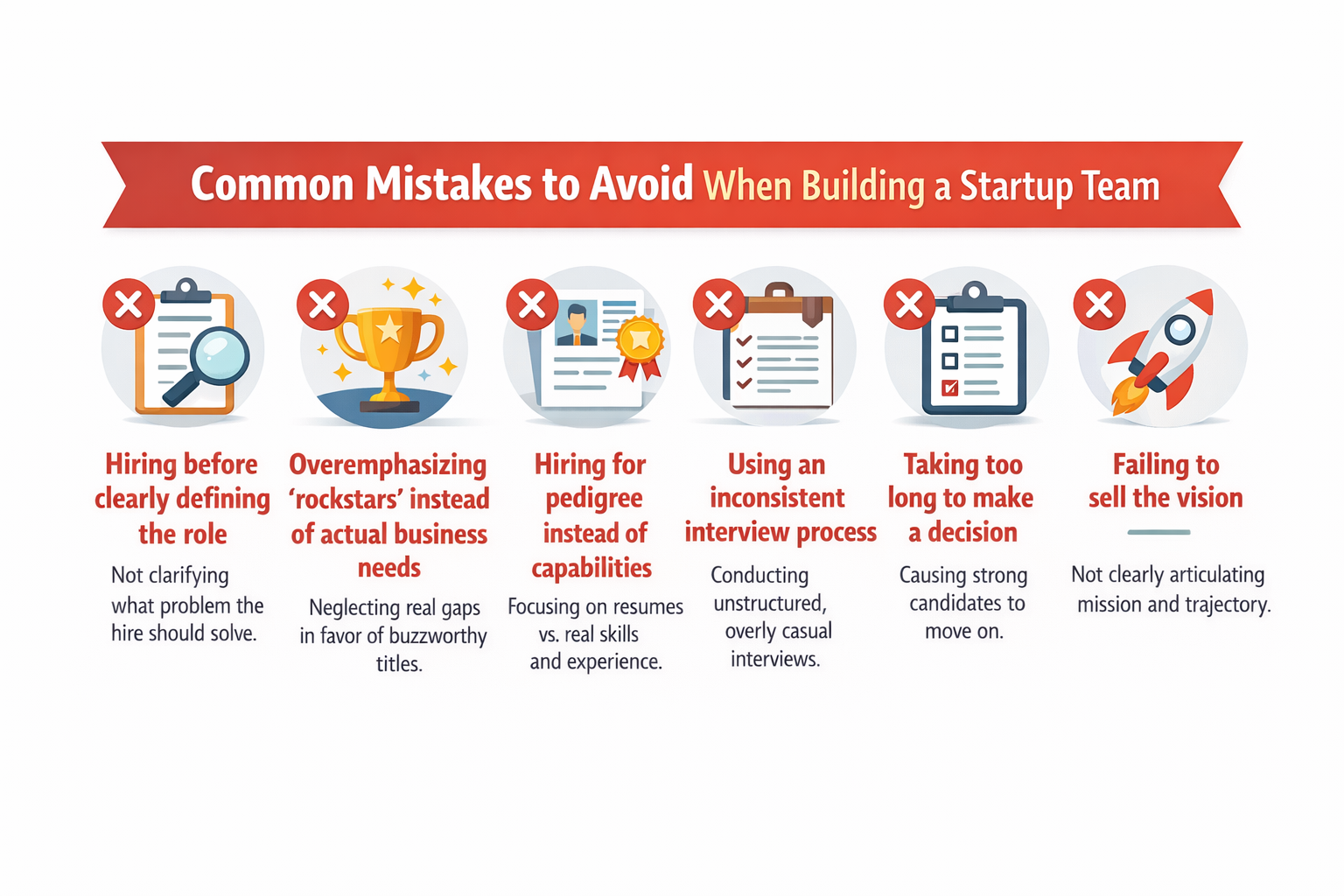
Common Mistakes to Avoid When Building a Startup Team
Even thoughtful founders can stumble when hiring early. We’ve spent years refining our approach and these are some of the most common mistakes we see and the ones that slow teams down later:
Hiring before clearly defining the role: Starting interviews without clarity creates mismatched expectations and weak outcomes. If you can’t clearly explain what this person will own and how success is measured, you’re not ready to hire yet.
Overemphasizing “rockstars” instead of actual business needs: Big titles and flashy backgrounds don’t always translate to early-stage impact. Focus on what the business needs right now and whether the candidate can operate effectively in a small, fast-moving team.
Hiring for pedigree instead of capabilities: Logos and past employers are easy to anchor on, but they don’t guarantee execution. Prioritize candidates who can clearly explain what they’ve built, owned, and delivered, especially in ambiguous environments.
Using an inconsistent interview process: Changing questions or evaluation criteria from candidate to candidate creates confusion and introduces bias. A consistent process produces clearer signals and faster decisions.
Taking too long to make a decision: Strong candidates rarely stay on the market for long. Slow feedback loops and drawn-out processes often cost you great hires rather than producing better ones.
Failing to sell the vision: Hiring is a two-way decision. If you don’t clearly communicate the mission, trajectory, and opportunity, candidates will fill in the gaps themselves or opt out entirely.
The Importance of Scalability When Creating Your Startup Team
When you build a startup team, it’s easy to hire for what hurts today. The better approach is to hire for what you’ll still need a year or many years from now. Early hires should solve immediate problems and help the company grow without forcing a reset every few months.
Start with go-to-market roles. In the early days, you don’t need a full sales org, you need people who can learn, adapt, and help define the motion. That might mean hiring a generalist who can sell, gather customer feedback, and refine messaging, rather than someone optimized for a mature, high-volume pipeline. Ask yourself: will this person help us figure out how we sell, not just close deals?
On the technical side, early engineering hires should think beyond shipping features. They’re setting patterns for how the product is built, tested, and maintained. Look for engineers who care about tradeoffs, documentation, and scalability, not just speed. A good early hire writes code that others can build on and easily understand.
Product and design hires also play a similar role. The right people can help translate feedback into clear priorities and simple solutions. When evaluating candidates, focus on whether they can operate with limited data and still make sound decisions, knowing the product will evolve as the company grows.
Leadership sequencing matters too. Early leaders should be comfortable doing the work themselves before managing others. A strong early leader builds process gradually, only when it’s needed, and avoids over-engineering too soon. Ask candidates how they’ve scaled teams in the past and what they intentionally didn’t build early.
When thinking about scalability, it helps to gauge each hire with a few simple questions, like:
Will this person stay effective as the team doubles?
Do they build systems, or just solve today’s problem?
Can they grow with the role, or will we need to replace them quickly?
At the end of the day, choose people who can grow as the company grows so your team evolves smoothly instead of in painful leaps. This mindset is the foundation of strong seed stage hiring and a critical part of learning how to build a startup team that scales.
When you build a startup team, it’s easy to hire for what hurts today. The better approach is to hire for what you’ll still need a year or many years from now. Early hires should solve immediate problems and help the company grow without forcing a reset every few months.
Start with go-to-market roles. In the early days, you don’t need a full sales org, you need people who can learn, adapt, and help define the motion. That might mean hiring a generalist who can sell, gather customer feedback, and refine messaging, rather than someone optimized for a mature, high-volume pipeline. Ask yourself: will this person help us figure out how we sell, not just close deals?
On the technical side, early engineering hires should think beyond shipping features. They’re setting patterns for how the product is built, tested, and maintained. Look for engineers who care about tradeoffs, documentation, and scalability, not just speed. A good early hire writes code that others can build on and easily understand.
Product and design hires also play a similar role. The right people can help translate feedback into clear priorities and simple solutions. When evaluating candidates, focus on whether they can operate with limited data and still make sound decisions, knowing the product will evolve as the company grows.
Leadership sequencing matters too. Early leaders should be comfortable doing the work themselves before managing others. A strong early leader builds process gradually, only when it’s needed, and avoids over-engineering too soon. Ask candidates how they’ve scaled teams in the past and what they intentionally didn’t build early.
When thinking about scalability, it helps to gauge each hire with a few simple questions, like:
Will this person stay effective as the team doubles?
Do they build systems, or just solve today’s problem?
Can they grow with the role, or will we need to replace them quickly?
At the end of the day, choose people who can grow as the company grows so your team evolves smoothly instead of in painful leaps. This mindset is the foundation of strong seed stage hiring and a critical part of learning how to build a startup team that scales.
Great VC Firms to Take You to the Next Step
As you move toward your next stage of growth, the right venture partner can make a meaningful difference when it comes to hiring, execution, and Series A readiness. Below are several VC firms that support early-stage founders as they build and scale their teams:
Bonfire Ventures: Bonfire Ventures leads Seed rounds in AI-powered B2B software companies and partners with founders from the earliest days through scale. The firm takes a high-conviction, low-volume approach, leads most investments, joins the board, and stays deeply involved with hiring, go-to-market strategy, and Series A preparation. Bonfire focuses on turning early traction into enduring momentum by working closely with founders on the decisions that matter most.
Benchmark: An early-stage venture capital firm investing in AI, open-source, marketplaces, infrastructure, and enterprise software.
Andreessen Horowitz: A stage-agnostic venture capital firm that backs tech entrepreneurs across AI, bio + healthcare, consumer, crypto, enterprise, fintech, games, and infrastructure.
Index Ventures: A global venture capital firm that works with entrepreneurs and their companies at every stage, across every sector.
Cowboy Ventures: A venture capital firm based in Palo Alto, California that invests in enterprise SaaS, fintech, software infrastructure, healthcare, consumer, and future of work sectors.
Costanoa Ventures: A firm that leads investments from formation through Series A in applied AI, AI infrastructure, cybersecurity, national security, and fintech.
Floodgate: A venture capital firm that focuses on early-stage investments in technology companies.
Build Your Startup Team With Intention
Building a startup team comes down to making the right decisions at the moments that matter most. Speed can create momentum, but intention is what sustains it as the company grows.
At Bonfire Ventures, we partner with founders at the earliest stages, when hiring decisions carry outsized weight. The teams that scale effectively are clear on what the business needs next, decisive once aligned, and thoughtful about who they bring into the company during its formative chapters. We see this approach lead to stronger execution, healthier team dynamics, and greater readiness for what comes next.
As you move from pre-seed to seed and beyond, aim to make hiring one of your highest-leverage responsibilities. The people you bring in early influence not just what gets built, but how the company operates under pressure and prepares for long-term growth. Founders who hire with intention give themselves a durable advantage and set their company up to scale with confidence when the opportunity is there.
FAQs on Building a Startup Team
What is the 80/20 rule for startups?
The 80/20 rule for startups, also known as the Pareto Principle, means roughly 80% of your results come from 20% of your efforts. In hiring, this shows up clearly. Your first few hires will have an outsized impact on product quality, speed, culture, and momentum. Getting those early roles right often matters more than adding headcount later. That’s why founders should spend more time on early hires and less time trying to optimize every small decision.
What are the five key elements for building a team?
Strong startup teams usually share five elements; clear roles, shared ownership, good judgment, open communication, and trust. Each person knows what they’re responsible for and takes initiative without waiting for direction. Teams that work well early also communicate openly, make decisions with limited information, and trust each other to execute.
What makes a good startup team?
A good startup team is small, aligned, and comfortable operating with ambiguity. Team members take ownership, communicate clearly, and make progress without needing constant direction. They balance speed with judgment, often moving fast, but knowing when a decision needs more thought because it will shape the company long term.
How long does it take to build a high-performing startup team?
Building a high-performing startup team doesn’t happen all at once. It can take months or years for a team to find the right rhythm as roles become clearer, processes form, and people grow into leadership responsibilities. The key is sequencing and making deliberate early hires, learning from each one, and letting the team evolve as the company scales rather than trying to build a “finished” org too early.