

Never miss an update. Join our newsletter.
You're in.Look for the next issue in your inbox.
11611 San Vicente Blvd. #650
Los Angeles, CA 90049
© 2026 Bonfire Ventures. All rights reserved.
October 7, 2026


What two and a half years of founder responses tell us about how AI is changing the way companies find their investors.
"How did you hear about us?" It's a simple question, but when you lead marketing at a venture firm, you spend a lot of time wondering whether the work is actually working. Founders' answers to it have become a surprisingly useful record of how they research investors, decide who belongs on their list, and, more and more, ask AI to help make the approach.
For most of Bonfire's history, the companies we've invested in came to us through people we know and trust: upstream and downstream investors, partners we work alongside, and founders who come back to us for their next company. About two and a half years ago, we made a bet that founders would start using large language models to research investors. We began investing in generative engine optimization, or GEO, with support from Growth Marketing Pro, so Bonfire would show up accurately when they did. At the same time, we added a proposal form to our website, asked founders how they found us, and started keeping track.
Over that period, the answers changed in two ways. AI went from absent to the most common response we get, and the way founders described using it became far more sophisticated.
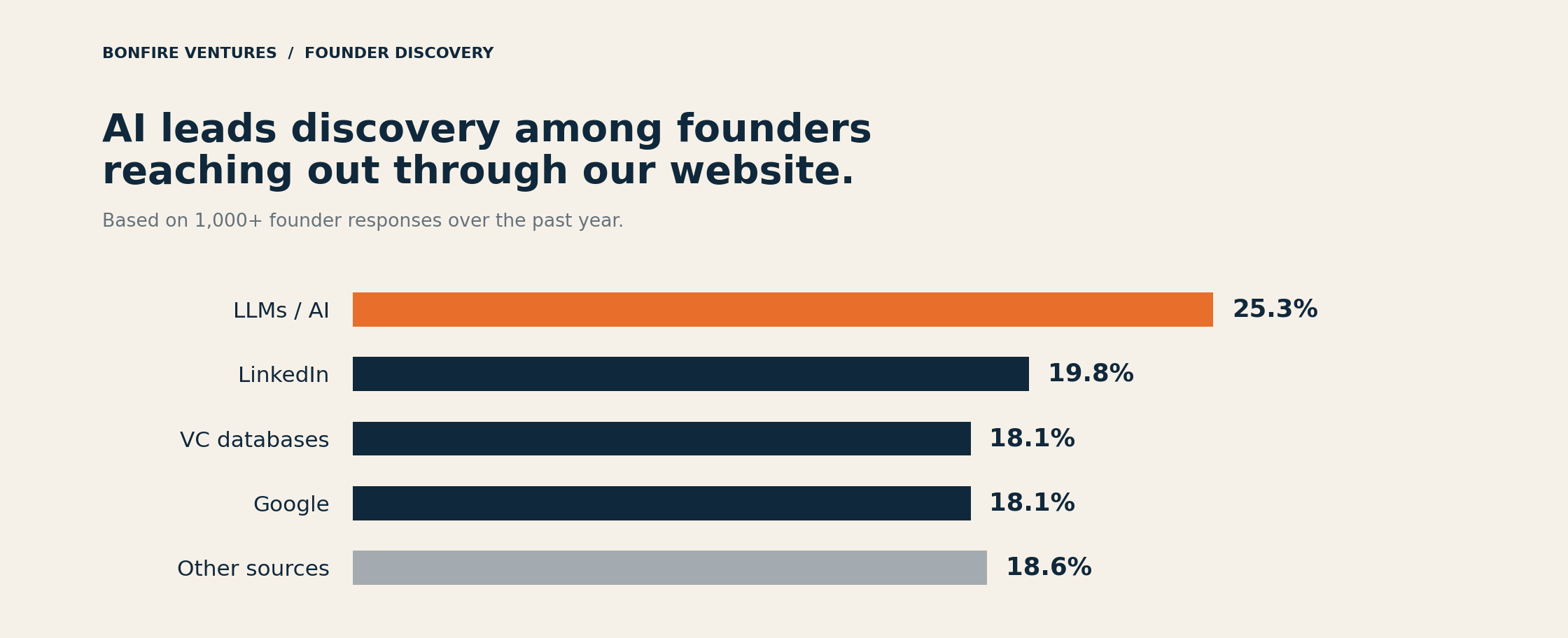
Across more than 1,000 website proposal responses over the past year, 25% named an LLM as the way they found Bonfire, ahead of LinkedIn at 20% and VC databases and Google at 18% each. For context, these figures cover founders reaching out through our website, not our broader sourcing through investor relationships, referrals, or companies our team seeks out.
To see how we got here, let’s look at the first responses from spring 2024. The answers were familiar. Founders mentioned LinkedIn, Crunchbase, Google, someone who knew us, or a post from one of our partners. ChatGPT first appeared in May 2024. That July, a founder wrote “AI search,” and by December, another wrote “ChatGPT Research.” Short answers, but a new channel worth watching.
Since then, both the frequency of those answers and the detail behind them have changed. Founders started telling us more than which tool they used. They told us what they asked it to do.
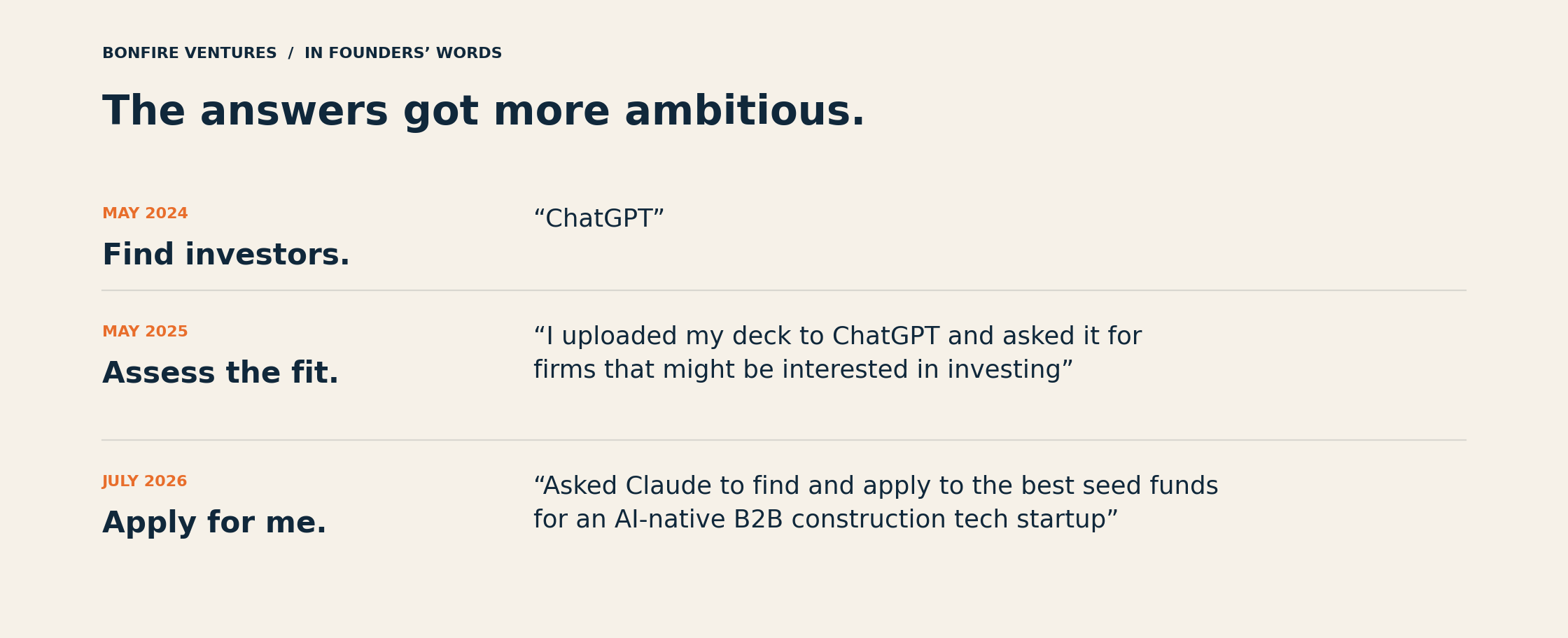
In May 2025, one founder told us, "I uploaded my deck to ChatGPT and asked it for firms that might be interested in investing." The founder was giving AI the specifics of their company and asking it to judge which firms made sense. Everything we publish, from our website and portfolio to our investment criteria and partner writing, becomes material it can draw on to make that call.
Responses grew more specific from there. Founders described asking about check size, stage, geography, and whether a firm had already backed a competitor. They were giving AI the constraints of their fundraise and asking it to narrow the field. That makes the reasoning behind a recommendation particularly interesting. Does the founder understand why Bonfire might be relevant, and does that understanding match what we actually invest in?
This September, one founder reported asking ChatGPT to analyze more than 1,000 investors and rank them by fit. They said Bonfire came out as their number-one priority, citing our focus on AI-native B2B, vertical AI, deep workflows, and products that improve with use. The specificity caught my attention. The founder could explain which parts of our thesis had put us at the top of their list.
Another founder described a system that reads what partners publish and scores funds on thesis fit, check size, and conflicts. It had read Brett Queener's essay, The Harness, the Horse, or the Hay, and used it as part of its assessment of Bonfire. Every marketer hopes their content helps people understand how the firm thinks. It is something else to hear that a founder's system read that content and used it to decide whether to approach you. Brett's readership now officially includes agents.
In July 2026, a founder told us they had "Asked Claude (Anthropic) to find and apply to the best seed funds for an AI-native B2B construction tech startup." Bonfire was on the list.
The founder had moved past using AI for research and asked it to act on their behalf.
The response doesn't confirm how much of the application Claude completed, but the request itself was a step beyond investor discovery.
I had to sit with that for a minute. Do we care whether a founder fills out our proposal form or their agent does? Not really. We care whether we’re a fit. Being recommended means little if we’re the wrong investor for your company. Founders want to spend time with investors who might back them. We want to meet companies we’d want to back. If AI gets us to that conversation faster, it’s doing something useful.
We lead seed rounds in AI-native B2B software, and we have a specific view of what makes these companies durable. Our investment criteria spell out what we look for. If your agent is researching investors or helping you apply, give it that context, along with your own. The most useful proposals tell us why Bonfire makes sense for the company you're building.
We don’t want to waste your time, your agent’s time, or your tokens. We want to find you as much as you want to find us. If your agent helps make the right introduction, I’m all for it. What matters is the company you’re building, not who filled out the form.