

Never miss an update. Join our newsletter.
You're in.Look for the next issue in your inbox.
11611 San Vicente Blvd. #650
Los Angeles, CA 90049
© 2026 Bonfire Ventures. All rights reserved.
December 22, 2025

At Bonfire, this question around durability comes up constantly — in investment discussions, in conversations with founders, and in how we think about supporting companies after we partner with them. As technical advantage compresses faster, we’ve found that many of the traditional signals we once leaned on feel less predictive on their own. What’s mattered more, in practice, is whether a company is building the kind of depth that can survive imitation and continue compounding as the environment shifts. Durability rarely appears fully formed; it emerges through product, customer, and organizational decisions that compound over time. Our role is to help teams recognize those decisions as they unfold — including the subtle shifts in workflow, behavior, learning, and operating rhythm that often become the foundations of real depth long before anyone sees them externally. We focus less on what looks differentiated today and more on what will remain essential once the surface converges.
This essay is an attempt to put structure around that intuition — not as a definitive answer, but as a working framework for how we think about durability today.
The half-life of technical advantage has collapsed — what once endured for years now persists for quarters, sometimes months. In this environment, the classic idea of defensibility feels increasingly incomplete. The more relevant question is not what keeps others out, but what keeps a company essential long after competitors inevitably arrive.
That shift has moved our thinking from defensibility to durability. Defensibility is about exclusion; durability is about endurance. The distinction feels subtle, but in practice it changes how companies are evaluated, how they are built, and how they are supported as the elements of real advantage begin to compound.
Over the last few years, the foundations of technical advantage have shifted. Advances in AI have reduced the gap between breakthrough and availability — what once required deep specialization now arrives as a widely usable tool. Open-source releases narrow the gap further, shrinking the time between innovation and imitation to months or even weeks. Infrastructure that used to demand significant internal sophistication — data pipelines, orchestration, evaluation, fine-tuning — is now packaged into increasingly mature abstractions.
The difficulty of building something impressive has fallen much faster than the difficulty of building something enduring. Technical novelty still matters, but it no longer behaves like a moat. It behaves like a starting point.
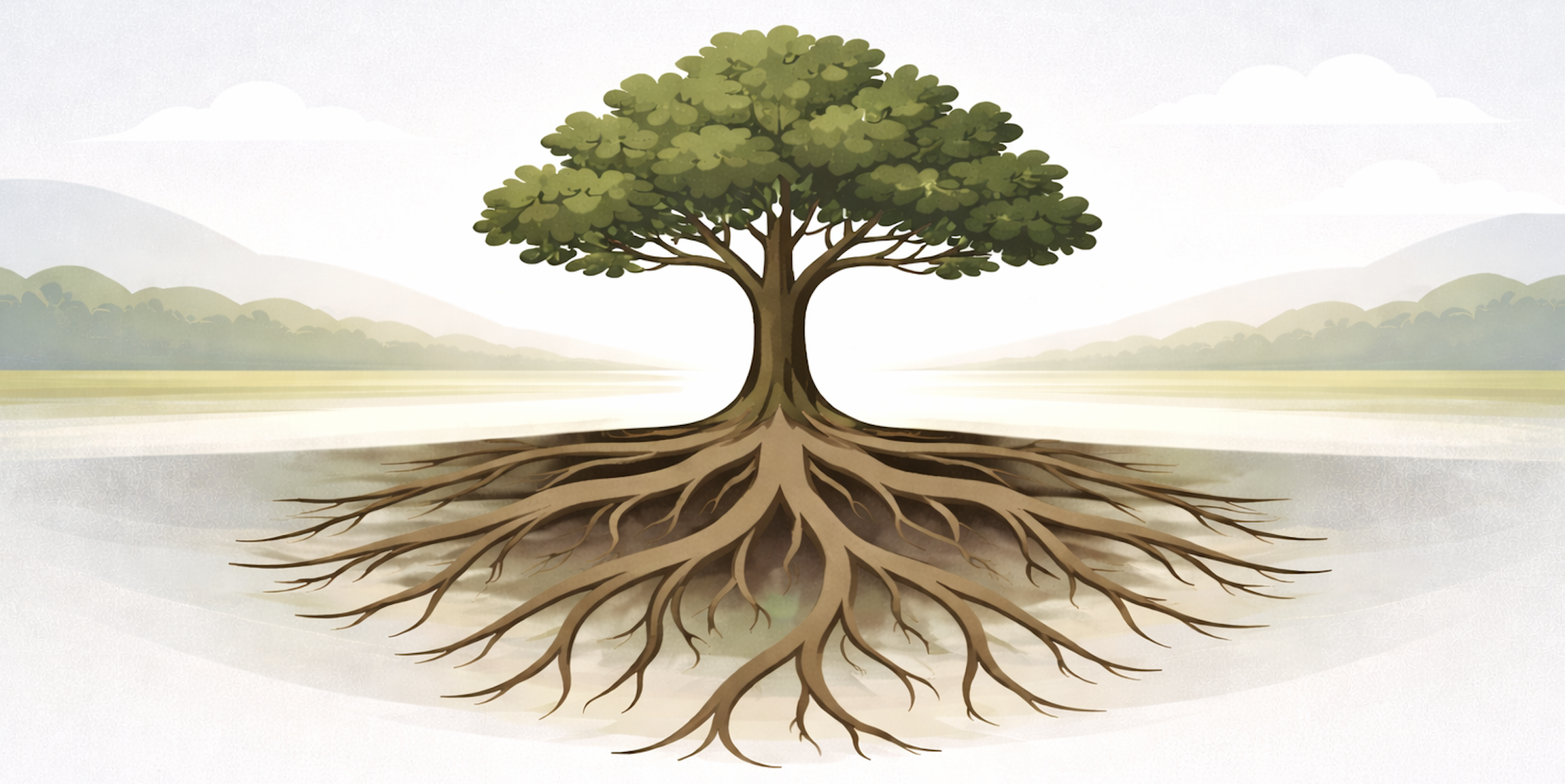
So durability can’t hinge on the brilliance of a model or the cleverness of an integration. It has to come from deeper structures — the parts of a company that persist even as the landscape crowds. And across conversations with founders, those structures tend to take the shape of roots: the elements of a business that strengthen quietly over time and are extraordinarily hard to replace once established.
Because while branches are easy to copy, roots are not. Branches are visible — features, interfaces, demos. They attract attention but travel quickly. Roots grow slowly, in workflows, behaviors, market insight, and organizational habits. These are the parts of a company that remain differentiated long after the visible differences fade.
Four types of roots seem to appear again and again, each reinforcing the next.
Many AI products accelerate isolated tasks but leave the underlying workflow intact. That creates value, but not depth. When the broader process remains unchanged, the product stays interchangeable. Durable companies reshape the workflow itself. They redefine how work is structured, how decisions move, what steps disappear, and how responsibilities shift. They don’t just make a process faster – they alter its logic. When that happens, the product becomes the operating rhythm of the team rather than a layer on top of it. Removing it is no longer a tooling change. It is a reorganization.
This is the first root — the shift that sets the foundation for everything else.
Once a workflow changes, behaviors follow. And in an environment where data is portable and systems are interoperable, behavioral switching costs can matter far more than technical ones. A durable product becomes the place where teams instinctively orient — where truth lives, where alignment forms, where progress is defined, and where decisions reside. These habits develop gradually, reinforced by repetition and shared language. Once embedded, they’re difficult to unwind.
In AI-native products, a second layer of stickiness forms: the accumulation of context. Over time, systems absorb a team’s preferences, corrections, edge cases, and domain knowledge. They build an internal understanding that reflects how the organization thinks and works. And as teams increasingly rely on agentic co-workers, that embedded context begins to live inside the agents themselves — creating a form of operational memory that is even harder to recreate elsewhere. This memory is rarely portable. Even if raw data can move, the intelligence the system has developed — the learned context — cannot. It is a form of lock-in that isn’t imposed; it’s earned through use.
Migration stops being about exporting data. It becomes about retraining an organization’s muscle memory and rebuilding the product’s understanding from scratch. Competitors can replicate functionality. They cannot replicate the behaviors — or the contextual intelligence — a team has built into a system over months or years.
This is the second root — where workflow depth begins to anchor itself in the organization, creating the conditions for everything that follows to take hold.
Workflow reshaping and behavioral stickiness anchor a company inside its customers. But the companies that widen their lead — rather than plateau — are those whose go-to-market functions operate as learning systems.
Over time, these teams develop sharper insight into which segments convert and why, what signals indicate real urgency, which objections reflect deeper issues, how customers actually navigate their workflows, and what product decisions meaningfully shift outcomes. This insight compounds. It reduces noise, improves prioritization, and creates a proprietary understanding of the market that competitors cannot see from outside. Two companies can look similar in product but diverge meaningfully in outcome because one is learning at a higher rate.
This is the third root — translating the first two into widening separation, as understanding compounds faster than features can.
The deepest root is organizational. If workflow reshaping sets the foundation, if behavior embeds it, and if GTM learning sharpens it, then organizational metabolism determines whether the company can keep earning its advantage as the environment shifts.
Metabolism is not just the ability to absorb new information, it is the ability to turn that information into coherent action at speed.
It reflects how quickly a company can:
In fast-changing environments, metabolism and velocity become indistinguishable. Companies that move slowly — not just in shipping features, but in making sense of the world — lose the ability to re-earn their advantage.
This metabolism ultimately traces back to leadership. A company can only grow as fast as its CEO’s capacity to scale their judgment, delegation, context-setting, and emotional range. The shift from managing a small, tight team to guiding a hundred first-principled employees is often where durability is either reinforced or lost. Founder velocity — how quickly a leader learns, reframes, and reallocates attention — sets the upper bound on the entire organization’s speed.
Most companies don’t fail because the idea was wrong. They fail because their metabolism stalls — they cannot adapt, cannot process the environment, cannot move at the pace required to re-earn their position.
This root sustains all the others.
Durability develops through systems, not moments. It begins with how the work is defined. It grows through the behaviors customers adopt. It compounds through what your company learns. And it solidifies through how your team adapts without losing clarity. In an AI-native world, imitation is fast. Endurance is earned.
The companies that win will be the ones whose roots grow deeper than their branches signal — those that remain essential even after competitors match their surface. But the precise shape of that depth will keep changing as the technology — and the organizations built on top of it — continue to evolve…
And so we will continue questioning it as we try to understand what truly endures: Durability, defined?