
OUR THESIS — WHAT WE BELIEVE ABOUT AI-NATIVE COMPANY BUILDING

AI-native isn't a feature. It's a different kind of company.

The best AI-native software learns from the work, so every customer makes it smarter, more useful, and harder to replace - from day one. That compounding is the whole thesis.

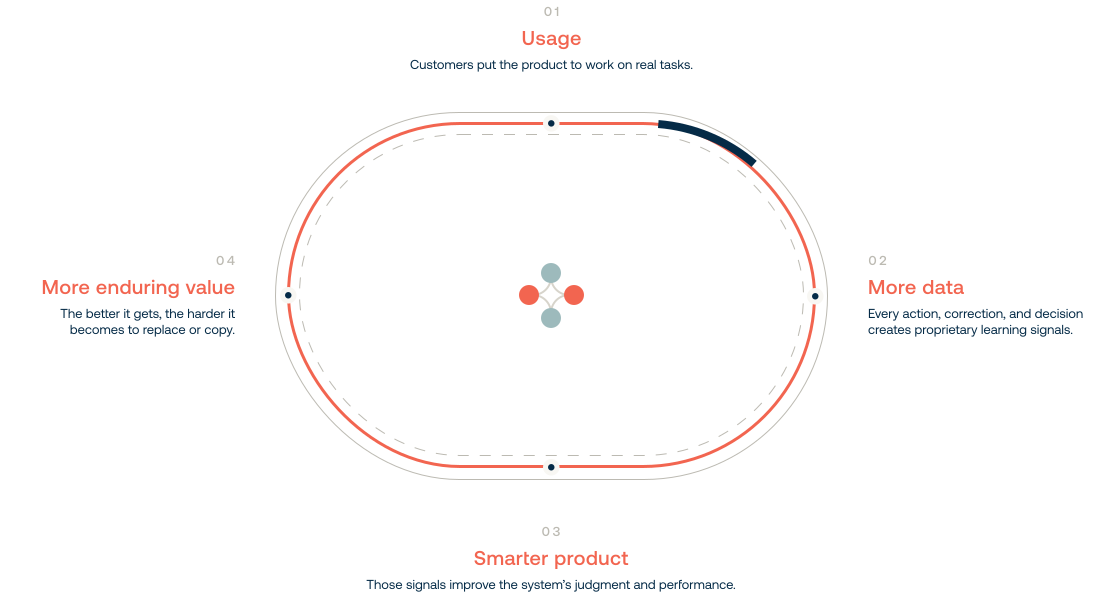
The compounding loop

Every use should make the product better.

The best teams design for this from day one, capturing context from each task, correction, and decision to improve what happens next. Over time, the product becomes more useful, more embedded in the workflow, and harder to replace.

Compounding loop showing usage, data, product intelligence, and enduring value

01

Usage

Customers put the product to work on real tasks.

02

More data

Every action, correction, and decision creates proprietary learning signals.

03

Smarter product

Those signals improve the system’s judgment and performance.

04

More enduring value

The better it gets, the harder it becomes to replace or copy.

WHAT WE BELIEVE

Five convictions that guide every check.

01

AI doesn't just improve software, it grows the market.

The biggest opportunities aren't better software. They're work software could never touch before - labor, services, and operations that lived in headcount budgets, not IT budgets. When an AI company does the job a team of people used to do, the market it sells into stops being the software line item and becomes the payroll line item. That's a different-sized prize.

02

Usage compounds the advantage.

When anyone can build the first version of a product in a weekend, durability cannot come from code alone. It comes from the proprietary context and judgment that accumulate through use. In markets with strong learning loops, leaders pull away because a better product earns more usage, and more usage makes the product better. We look for companies that become harder to compete with as they grow.

03

The judgment layer is the hard part.

AI can generate, summarize, and automate. That is table stakes now. The hard part is judgment: what matters, what to trust, when to escalate, and how to handle the exception nobody documented. For a claims adjuster, a controller, or a nurse, the value was never in the typing. It was in knowing what to do. We back companies that build that judgment into the product because it is the hardest part for competitors to copy.

04

Workflow depth is the moat.

The easiest products to build are also the easiest to copy. We are drawn to the messy workflows with multiple stakeholders, compliance requirements, approvals, handoffs, and edge cases that only reveal themselves when you have lived the work. A commercial roofer’s change order that must trigger a lien waiver is not glamorous. It is exactly the kind of specific, consequential problem that keeps competitors out.

05

AI fluency starts at the top.

We do not expect every CEO to write code, but we do expect them to work with AI firsthand. They should understand what the models can and cannot do, how they change the product, and how the company should operate differently because of them. AI cannot be delegated to engineering. If it is central to the product, it must be central to how the CEO leads.

WHERE WE INVEST

Six places where AI creates structural, compounding advantage.

We don't index on industry, we index on the shape of the advantage. Some of what we back is built deep for one industry; some is horizontal infrastructure used across many. What stays constant is that the advantage compounds. Here's where we look:

Vertical AI Software

Our highest-conviction category. AI software built for the real work of a single industry, like healthcare, construction, legal services, or logistics. The product runs core workflows instead of sitting on top as a generic horizontal tool.

You’re a fit if:

You're building for one vertical with workflow complexity, a clear buyer, and your edge is knowing the work better than anyone.

Read the full Vertical AI thesis

Read the thesis

AI + Proprietary Data

Companies built on data that cannot be crawled, licensed, or bought. It is earned by operating in the domain, compounds with every customer, and can become the shared intelligence layer for an entire industry.

You’re a fit if:

Your data advantage is structural, and something a well-funded competitor couldn't recreate just by spending.

Read the full Proprietary Data thesis

Read the thesis

Services-to-Software

For every dollar spent on software, six are spent on services. These companies deliver services with software economics. We back builders that own their data and improve margins with every job, not dispatchers reselling the same intelligence.

You’re a fit if:

You compete with people, not software, and each job makes your business faster, more profitable, and harder to copy.

Read the full Services-to-Software thesis

Read the thesis

Fintech Infrastructure

AI gets things mostly right. Money and compliance have to be right every time. These companies build auditable rails for payments, ledgers, risk, and KYC/AML. As more of the economy runs on AI, more volume flows through their infrastructure.

You’re a fit if:

You operate where accuracy and trust are non-negotiable, in a regulated or transaction-heavy environment.

Read the full Fintech Infrastructure thesis

Read the thesis

Agent-Native Infrastructure

The core infrastructure other companies build their agents on: identity, payments, orchestration, trust, and observability. This category is crowded, so we invest only when the problem is new and a seed-stage company can become the standard.

You’re a fit if:

Builders already choose you as the default for a critical layer of their stack, with usage that strengthens your advantage.

Read the full Agent-Native thesis

Read the thesis

Structural Reshaping

Our contrarian bet. AI will reshape markets by removing middlemen, unbundling services, and expanding industries that friction kept small. We look for shifts already underway but still early enough for a new company to define the market.

You’re a fit if:

You’re changing how an entire market works, not just making one workflow more efficient.

Read the full Structural Reshaping thesis

Read the thesis

Read the thesis in depth

Tales from
the Bonfire.

Brett's ongoing writing on AI defensibility, the compounding loop, and where durable value gets built.

Read the full series